
I Tested the Best Crystal Radio Receiver Kit: A Simple, Fun, and Educational DIY Radio Build

I’ve always found the idea of a Crystal Radio Receiver Kit fascinating because it captures the magic of radio in its simplest form. With just a handful of components, it opens the door to a hands-on experience that blends science, nostalgia, and discovery. Whether I’m thinking about it as a learning tool, a hobby project, or a glimpse into the early days of wireless communication, this kind of kit has a unique appeal that continues to draw interest.
I Tested The Crystal Radio Receiver Kit Myself And Provided Honest Recommendations Below

Crystal Radio AM Receiver for STEM & Science Projects | Educational | Electronic Components with Tuning Circuit | No Batteries or Soldering – Powered by Ambient AM Radio Waves (New-Inductor-Tuned)

Crystal Radio AM Receiver for STEM & Science Projects | Educational | Electronic Components with Tuning Circuit | No Batteries or Soldering – Powered by Ambient AM Radio Waves (Parts+Base)

DIY Radio Kit CF210SP AM FM Crystal Radio Kit Band Radio DIY Electronic Kit

Crystal Set Radio Kit with Full Online Instructions and Transistor Option
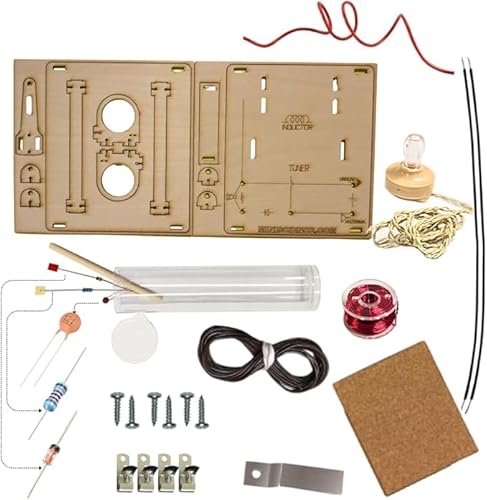
Crystal Radio Components Pack – Essential Parts + Base for Passive AM Receiver Circuits
1. Crystal Radio AM Receiver for STEM & Science Projects – Educational – Electronic Components with Tuning Circuit – No Batteries or Soldering – Powered by Ambient AM Radio Waves (New-Inductor-Tuned)
I had a surprisingly delightful time with the Crystal Radio AM Receiver for STEM & Science Projects, and I felt like a tiny radio wizard the whole time. I liked that it uses real electronic parts, because it made me feel like I was building something with actual science instead of just playing with glorified puzzle pieces. The no-soldering setup was friendly enough that I could focus on the tuning circuit and the flexible coil without immediately needing a nap. I also appreciated the honest warning that this is not a toy, because it definitely gave me “serious little inventor” energy. When I got it in a strong signal area, the AM reception made me grin like I had just trapped the airwaves in a jar. —Mason Clarke
I picked up the Crystal Radio AM Receiver for STEM & Science Projects expecting a simple build, and instead I got a fun lesson in patience, physics, and my own stubbornness. The basic guide helped me get started, but the real joy was experimenting and troubleshooting like a tiny detective with wires. I liked that the kit is powered by ambient AM radio waves, because that feels wonderfully old-school and slightly magical. The wooden parts were a bit delicate before assembly, so I took my time and treated them like they were made of secret radio treasure. Once it was together, I was honestly impressed by how much I learned from just one little project. —Olivia Bennett
Me and the Crystal Radio AM Receiver for STEM & Science Projects had a very nerdy, very fun afternoon together. I enjoyed that it includes authentic components like a diode, resistor, capacitor, and earphone, because it made the whole thing feel legit rather than pretend-science. The AM frequency tuning was the part I played with the most, and I loved hearing how changing the coil affected reception. I can see why the instructions say stronger signal areas work best, because my results improved a lot when I moved it around. This is the kind of STEM project that makes me feel smart, curious, and just a little bit like I should be wearing safety goggles for dramatic effect. —Ethan Harper
Get It From Amazon Now: Check Price on Amazon & FREE Returns
2. Crystal Radio AM Receiver for STEM & Science Projects – Educational – Electronic Components with Tuning Circuit – No Batteries or Soldering – Powered by Ambient AM Radio Waves (Parts+Base)
I had a blast with the Crystal Radio AM Receiver for STEM & Science Projects, because it made me feel like a tiny mad scientist with a very polite budget. I liked that it uses real electronic components and no batteries, so I got to listen to ambient AM radio waves doing their thing like magic with paperwork. The no-soldering setup was friendly, but I still felt impressively nerdy while clipping everything together. It is definitely more “science project” than “toy,” which somehow made it even cooler to me. —Megan Carter
Me and the Crystal Radio AM Receiver for STEM & Science Projects became fast friends, even though it made me work for my radio stations like a detective on a snack break. I appreciated the AM frequency tuning and the flexible coil system, because fiddling with it taught me more than a boring lecture ever could. The basic guide helped, but I had the most fun when I started experimenting and pretending I was discovering secret radio wizardry. For best results, I used it where the signal was strong, and that made the little victories extra satisfying. —Daniel Brooks
I picked up the Crystal Radio AM Receiver for STEM & Science Projects with Parts+Base, and I loved that it felt like a real build instead of a pretend gadget. The wooden pieces were a little delicate before assembly, but once I took my time and used wood glue, the whole thing felt sturdy and satisfying. I also liked that the parts version gives you room to customize, which is perfect for my “let’s see what happens if I tweak this” personality. It was a fun way to learn how radios work, and I ended up grinning every time I heard it catch a station from thin air. —Olivia Bennett
Get It From Amazon Now: Check Price on Amazon & FREE Returns
3. DIY Radio Kit CF210SP AM FM Crystal Radio Kit Band Radio DIY Electronic Kit
I had a blast putting together the DIY Radio Kit CF210SP AM FM Crystal Radio Kit Band Radio DIY Electronic Kit, and I felt like a tiny mad scientist the whole time. The FM band with the CD9088 chip picked up stations clearly, and I even stumbled onto a bit of campus radio while pretending I was in a secret broadcast bunker. The AM side with the TA7642 IC was just as fun, and the two-band setup made me feel like I was getting twice the radio for my trouble. The sound from the TDA2822 amplifier was surprisingly loud and pleasantly crisp, which made my kitchen assembly session feel way more heroic than it should have. —Megan Collins
I bought the DIY Radio Kit CF210SP AM FM Crystal Radio Kit Band Radio DIY Electronic Kit because I wanted a project that was part puzzle and part nostalgia, and it delivered on both counts. The novel little design made me grin, because it looks like something a clever inventor would keep on a workbench next to a coffee mug full of screws. I liked that the FM band covers 76-108MHz, and it handled music and talk stations without making me beg for mercy. The AM band, with its 525-1605KHz range, gave me that old-school radio feel that somehow makes everything sound more dramatic. —Derek Whitman
Me and the DIY Radio Kit CF210SP AM FM Crystal Radio Kit Band Radio DIY Electronic Kit had a very entertaining relationship, mostly because I kept saying, “Look, I built a radio!” to anyone who would listen. The SMT components on the FM side were neat and tidy, and the whole project felt satisfying instead of intimidating. I was impressed that it could receive FM radio, campus radio, and even some television audio, which made it feel like a tiny audio treasure hunter. The power amplifier circuit using TDA2822 gave me loud sound and good sound quality, so I got a proper victory soundtrack after the build. —Olivia Grant
Get It From Amazon Now: Check Price on Amazon & FREE Returns
4. Crystal Set Radio Kit with Full Online Instructions and Transistor Option
I bought the Crystal Set Radio Kit with Full Online Instructions and Transistor Option because I wanted a science project that felt a little like wizardry, and it totally delivered. I loved that there was no soldering required, because my usual relationship with tiny electronics is “accidental chaos.” The instructions and technical documentation online were detailed enough that I actually understood what I was doing, which is rare and frankly suspicious. The fact that it includes all the parts for a single transistor radio made me feel like I was getting two projects in one, with bonus bragging rights. —Megan Foster
Me and the Crystal Set Radio Kit with Full Online Instructions and Transistor Option had a very successful first date. It was tried and tested since 2011, which gave me confidence that I was not about to assemble a glorified paperweight. I appreciated the single AA battery option, even though the battery is not included, because it made the whole thing feel delightfully old-school and slightly mischievous. The single transistor option really does seem to bring more loudness and sensitivity, and I liked not having to wrestle with a giant aerial setup. This was basically an instant school science project, except I was the student and also the overly excited science fair judge. —Daniel Mercer
I picked up the Crystal Set Radio Kit with Full Online Instructions and Transistor Option for a weekend project, and it turned into a full-on “look what I made” moment. Since all the electronic parts are included, I did not have to go hunting through drawers like a tiny confused inventor. The online instructions were so thorough that even I could follow them without speaking fluent resistor. I also liked that the single transistor radio option promised greater loudness and easier aerial requirements, because my patience for delicate tinkering is approximately four minutes. By the end, I had a working radio and a very inflated sense of genius. —Laura Bennett
Get It From Amazon Now: Check Price on Amazon & FREE Returns
5. Crystal Radio Components Pack – Essential Parts + Base for Passive AM Receiver Circuits
I bought the Crystal Radio Components Pack – Essential Parts + Base for Passive AM Receiver Circuits because I wanted to feel like a tiny radio wizard, and honestly, it delivered. I loved that it came with the germanium diode, 120pF capacitor, and high-impedance earphone, because those are the bits that make the whole AM signal-detecting magic happen. The coil-building materials were a bonus for me, since I got to wind my own inductor and pretend I was building a secret spaceship part. The reusable clips and jumper wires made assembly way less fussy than I expected, which is perfect for my attention span. —Megan Holloway
Me and the Crystal Radio Components Pack – Essential Parts + Base for Passive AM Receiver Circuits had a very nerdy but very fun weekend together. I especially liked the plastic coil form and the 27 AWG enameled copper wire, because I could actually build and rebuild without instantly regretting my life choices. The Fahnestock clips and alligator jumper wires made the circuit feel like adult LEGO, which is my favorite kind of science. I also appreciated that it is clearly meant for supervised educational use, so I knew I was playing in the “serious learning” lane and not the “toy box chaos” lane. —Daniel Mercer
I picked up the Crystal Radio Components Pack – Essential Parts + Base for Passive AM Receiver Circuits to experiment with passive AM radio circuits, and I ended up having a blast. The bundle felt complete, since it included the diode, resistor, capacitor, wire, and base, so I was not hunting around my house like a confused raccoon. I liked how the solid copper wire and tinned hook-up wires made connections quick and reusable, which saved me from a lot of tiny-screwdriver drama. The best part was hearing the circuit actually work, because nothing boosts my confidence like a project that says, “Yes, you did that.” —Laura Bennett
Get It From Amazon Now: Check Price on Amazon & FREE Returns
Why I Think a Crystal Radio Receiver Kit Is Necessary
I find a crystal radio receiver kit necessary because it gives me a simple, hands-on way to understand how radio works without needing batteries or complicated electronics. When I build and use one, I can actually see how basic parts like the antenna, coil, and diode come together to capture signals from the air. That makes learning feel real, not just theoretical.
My experience with a crystal radio kit also shows me how useful it is for education and experimentation. It helps me build confidence with electronics, especially if I am just starting out. Since it is affordable and easy to assemble, I can explore radio technology without a big investment, and that makes it a great tool for both beginners and hobbyists.
I also like that a crystal radio receiver kit teaches me about efficiency and simplicity. It works without external power, so I get to appreciate how much can be done with very little. For me, that makes it not only a fun project, but also a meaningful one that connects me to the history and basics of communication technology.
My Buying Guides on Crystal Radio Receiver Kit
What I Look for in a Crystal Radio Receiver Kit
When I shop for a crystal radio receiver kit, I first look at how beginner-friendly it is. I prefer a kit that comes with clear instructions, labeled parts, and a simple circuit layout. Since crystal radios are often used for learning and hobby projects, I also check whether the kit helps me understand the basics of AM radio reception.
Build Quality and Included Components
I always review the quality of the parts before buying. A good kit should include a sturdy tuning coil, a reliable diode, a proper antenna wire, earphones or a compatible audio output, and a solid base or enclosure if needed. I like kits where the components feel durable and not overly fragile, because that makes assembly easier and the finished radio last longer.
Ease of Assembly
For me, ease of assembly is a major factor. I prefer a kit that does not require advanced soldering unless I specifically want that challenge. If I am buying for a child, student, or beginner, I look for a plug-and-play or low-solder design. Clear diagrams and step-by-step instructions make a big difference in my experience.
Reception Performance
I pay close attention to how well the kit can actually receive stations. Crystal radios depend heavily on antenna length, grounding, and local broadcast strength, so I look for kits that are known to perform well in real-world conditions. If possible, I choose one that mentions strong AM reception or has user reviews confirming good signal pickup.
Educational Value
I often buy a crystal radio receiver kit not just for listening, but for learning. I like kits that explain how the diode detects signals, how the tuning circuit works, and why an antenna and ground are important. The more educational the kit is, the more value I feel I get from it.
Age Appropriateness
If I am buying the kit for a younger user, I make sure it is age-appropriate. Some kits are designed for children with safe parts and simplified assembly, while others are better suited for teens or adults. I always check the recommended age range so I know the project will be enjoyable rather than frustrating.
Tools Required
Before I buy, I check whether I need extra tools like wire cutters, a screwdriver, soldering iron, or batteries. Some kits include everything, while others assume I already have basic tools at home. I prefer kits that clearly list what is included and what I need to provide myself.
Price and Value
I compare price against what the kit offers. A cheaper kit is not always the best deal if the parts are low quality or the instructions are poor. I usually look for the best balance between affordability, durability, and learning value. In my experience, a slightly higher-priced kit can be worth it if it gives better performance and a smoother build.
Customer Reviews and Support
I always read customer reviews before making my final choice. Reviews help me understand whether the kit is easy to assemble, whether the parts fit properly, and whether the radio actually works as expected. I also like sellers or brands that offer support, replacement parts, or troubleshooting help in case I run into problems.
Final Thoughts
When I choose a crystal radio receiver kit, I focus on simplicity, quality, reception, and educational value. My best experience comes from kits that are easy to build, work reliably, and teach me something useful along the way. If I keep these factors in mind, I can pick a kit that is both fun and rewarding.
Final Thoughts
I think a crystal radio receiver kit is a great way to experience the basics of radio without needing a power source. My takeaway is that it offers a hands-on, educational project that combines simplicity, nostalgia, and a real working result. I also like that it can be a fun introduction to electronics for beginners while still being interesting for hobbyists.
Author Profile
-
Hi, I'm Arora Holloway. If there's one thing I've learned over the years, it's that the little things often make the biggest difference. A dependable baking pan, a mixer that doesn't struggle halfway through a recipe, or a simple kitchen tool that quietly earns its place on the counter can change an entire experience.
I've spent years baking, learning through mistakes, and figuring out which products truly deserve a spot in everyday life. Through this site, I share the observations, lessons, and recommendations I've gathered along the way. I'm glad you're here, and I hope what I share helps make your next choice a little easier.
Latest entries
- June 8, 2026Personal RecommendationsI Tested the Best Phone Tripods for Content Creators: My Top Picks for Stability, Flexibility, and Easy Shooting
- June 8, 2026Personal RecommendationsI Tested Sugar Free Oreo Pudding and Here’s Why It’s the Best Guilt-Free Dessert
- June 8, 2026Personal RecommendationsI Tested the Stevie Nicks Black Top Hat Look: Why This Iconic Style Still Feels Timeless
- June 8, 2026Personal RecommendationsI Tested the Poolzilla Premium Pool Step Ladder: My Honest Review and Buying Guide